Skip to content
Lord Surya

Lord Surya

सूर्य

The Sun God and Source of Life

2 mantras available

About Lord Surya

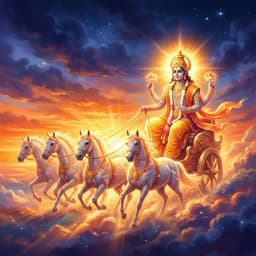
Lord Surya, the Sun God, is one of the most ancient deities in Hinduism, worshipped since Vedic times as the visible form of the divine. He is Pratyaksha Brahman — the God who can be seen with the naked eye. The Rigveda contains numerous hymns dedicated to Surya, acknowledging him as the source of all life, energy, and consciousness on Earth. He rides a chariot drawn by seven horses representing the seven days of the week and the seven colors of light.

Surya is depicted as a radiant golden deity seated on a lotus, holding two lotus flowers, with a brilliant halo of light surrounding him. His charioteer is Aruna (the dawn), and his seven horses are named after the seven Vedic meters (Gayatri, Brihati, Ushnik, Jagati, Trishtubh, Anushtubh, and Pankti). Surya is the father of many important figures, including Karna, Sugriva, Yama (god of death), and Shani (Saturn).

Surya mantras are among the most powerful in the Vedic tradition. The Gayatri Mantra, addressed to Savitar (a form of Surya), is considered the most sacred mantra in Hinduism. Surya Namaskar (Sun Salutation) combines physical postures with mantra chanting. Worshipping Surya brings health, vitality, leadership qualities, and removes diseases, especially those related to the eyes, heart, and bones.

Attributes & Symbolism

1Golden Radiance
2Chariot with Seven Horses
3Two Lotus Flowers
4Aruna (Charioteer/Dawn)
5Halo of Light
6Sudarshana (Disk of Light)
7Ruby Gemstone
8Copper Metal

All Lord Surya Mantras

Frequently Asked Questions

Lord Surya, the Sun God, is one of the most ancient deities in Hinduism, worshipped since Vedic times as the visible form of the divine. He is Pratyaksha Brahman — the God who can be seen with the naked eye. The Rigveda contains numerous hymns dedicated to Surya, acknowledging him as the source of all life, energy, and consciousness on Earth. He rides a chariot drawn by seven horses representing the seven days of the week and the seven colors of light. Surya is depicted as a radiant golden deity seated on a lotus, holding two lotus flowers, with a brilliant halo of light surrounding him. His charioteer is Aruna (the dawn), and his seven horses are named after the seven Vedic meters (Gayatri, Brihati, Ushnik, Jagati, Trishtubh, Anushtubh, and Pankti). Surya is the father of many important figures, including Karna, Sugriva, Yama (god of death), and Shani (Saturn). Surya mantras are among the most powerful in the Vedic tradition. The Gayatri Mantra, addressed to Savitar (a form of Surya), is considered the most sacred mantra in Hinduism. Surya Namaskar (Sun Salutation) combines physical postures with mantra chanting. Worshipping Surya brings health, vitality, leadership qualities, and removes diseases, especially those related to the eyes, heart, and bones.
MantraList.in features 2 mantras dedicated to Lord Surya. These include various types such as beej mantras, gayatri mantras, stotras, and devotional prayers. Each mantra serves a specific spiritual purpose and carries unique benefits.
All Lord Surya mantras carry divine power when chanted with devotion and sincerity. The most widely chanted Lord Surya mantra is often considered to be the primary mantra associated with this deity. The effectiveness of any mantra depends on the practitioner's faith, consistency, and correct pronunciation rather than any inherent hierarchy.
Yes, Lord Surya mantras can be chanted at home in a clean, quiet space. Face east or north while chanting. You can set up a small altar or simply sit in a calm corner. The most important factors are devotion, regularity, and a peaceful mind. Morning hours (especially Brahma Muhurta) are traditionally considered the most auspicious time.
Worshipping Lord Surya through mantras and prayers brings spiritual growth, inner peace, and divine blessings. Devotees experience increased clarity, protection from negative energies, fulfillment of righteous desires, and progress on the spiritual path. The specific benefits vary by mantra -- explore each mantra page for detailed information.